Studying Abroad? These Are The Best Destinations For International Students

Are you a student who thinks like everyone is moving ahead, and you are still in the same place on your university campus? And you are not the only person who has found himself daydreaming about studying somewhere you have never visited, where you have people whose cultural backgrounds are different.
One of the most popular experiences among students all over the world nowadays is studying abroad and choosing the best destinations for international students. It’s more than just earning a degree from a foreign university.
At this point, it is more about putting yourself in a new environment, learning about different cultures, and having the experiences that cannot be duplicated in a standard classroom. Although the experience will be daunting, it’s going to be worth it.
The world is stretching in front of you, as if it were made of cobblestone alleyways of European university towns or a large campus of North America and Asia.
This guide will familiarize you with the best places for an international student to visit. You will see what you actually should look for when deciding on a destination so you can make a decision that is suited to your goals, your budget, and your lifestyle.
So, without further ado, let’s get into the topic.
What to Look for in a Study Abroad Destination

Choosing the country is the most difficult stage when you have thousands of universities in your list. But students find their right place by focusing on specific key factors.
This will help them before making a final decision, by keeping everything simple and looking closely at what really matters and what is important.
Make sure you read these points carefully before making any decision.
- To look at Academic quality. You can check the global ranking of universities, but focus on the specific department you want to study. Because sometimes universities are not top-ranked overall but can still be excellent in your subject area.
- Cost is the main factor in choosing any university. You must check the tuition fee and living expenses of the country. Other countries, such as Norway and Germany, are cheaper than the UK and Australia, hence you can consider these countries before you settle on any given decision.
- Then, also examine the quality of life, environment, and healthcare in the country of choice.
- Another factor that should be considered is language. Ensure that the programs are in the English language or in the indigenous language of the country in question. When you plan to remain after graduation or have experience, check after-study employment opportunities and part-time work policies.
- Admission requirements and scholarships are also of great importance. Ensure you check the entry requirements early to ensure that you meet them in time. Another thing you should do is to find scholarship opportunities, which can save you a lot of money and increase your prospects of being accepted.
Now that you are aware of what to expect in a destination, we are going to know the global trend of international students.
The Global Study Abroad Surge: Numbers, Trends, and What Comes Next
The trend of studying abroad is increasing all around the world. Project Atlas estimates that there were 6.9 million foreign students in higher education in 2022. This was an 8% growth over the last year. Additionally, UNESCO also estimates that this figure might be about 8.5 million in 2030.
The reasons are also evident: 98% of students claim that studying overseas enhanced the comprehension of their own cultural values, and 75% claim that they acquired skill sets that had a direct impact on their professional decisions.
International graduates are more frequently given more professional responsibility, according to about 64% of companies surveyed.
Fifty percent of international students prefer studying in the United States, the United Kingdom, Germany, France, and Australia. The trend, however, is changing. Moreover, students are venturing into studying in Europe and Asia due to an increase in tuition fees. Also, the immigration rules are becoming stricter in traditional destinations.
So the question is, where should you go? Here is a close look at the most popular study destination.
The Best Destinations for International Students
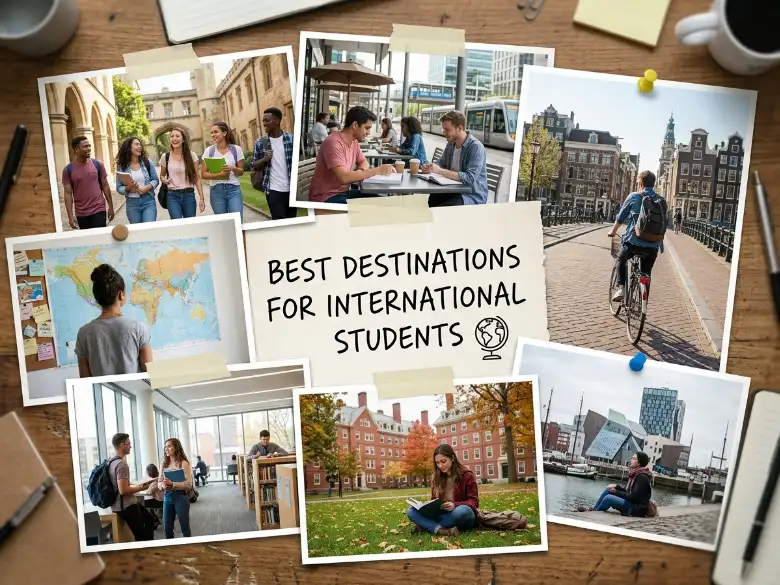
Here’s a compilation of the best destinations for international students:
1. Germany
Germany is considered one of the most valuable countries. Since 2014, most state-supported universities have not been collecting tuition. Students simply pay a few semester fees of approximately 250 euros.
Currently, there are over 440,000 international learners in Germany. Most people prefer coursework such as business, science, and engineering.
You can also study there in English. Many master’s programs are taught in English, so you do not always need to know German.
2. United Kingdom
The United Kingdom is home to some of the most reputable universities in the world, such as Oxford, Cambridge, Imperial College, and UCL. The USA and the UK have the highest number of universities in the QS top 10 worldwide academic programs, with four schools each from both countries.
The length of the programs is one practical benefit that tends to entice students to choose these nations. Because undergraduate degrees take three years instead of four, the greater tuition costs are partially compensated. International students can stay and work in the UK for two years after earning their degree, thanks to the Graduate Route visa.
But it has its disadvantages: the average monthly rent in the UK is over 1000, which is one of the more expensive items on this list.
3. Canada
Canada is ranked among the best countries for international students. Most of the students prefer it due to its well-known universities. The cities are also safe and diverse. Its immigration rules are also more flexible compared to those of many other countries.
A lot of students take their studies as a means of remaining longer. Initiatives such as the Post-Graduation Work Permit (PGWP) allow graduates to work up to three years after completing their degree.
Students come to Canada from many countries, such as India, China, Ghana, and Nigeria.
4. Australia
Increasingly, students are opting to study in Australia. It is a tourist spot due to its quality of life, good research, and employment after graduation. During their study period, international students are allowed to work 48 hours in 2 weeks to assist them in covering their living expenses.
The Group of Eight also includes some of the best universities in Australia, such as the University of Melbourne, the Australian National University (ANU), and the University of Sydney. After the pandemic, Australia once again became one of the top 25 study destinations in the world.
Asian/South Asian students like Australia due to its nice weather, outdoor culture, and easy lifestyle.
5. The Netherlands
The Netherlands is among the leading countries in international education. The country has six universities that are ranked in the top 100 of the QS World University Rankings. The Delft University of Technology is particularly reputable due to its good engineering and technology programs.
A large part of the courses is taught in English, which is one of the main benefits of the Netherlands. It also has more degrees taught in English as compared to most non-English-speaking countries. Amsterdam and Eindhoven are cities that are favored by students. The nation is also reputed to be extremely accommodating to foreign students.
The price of education and living is a little higher than in Germany, yet lower than in the UK.
6. Japan
To those students who are willing to think outside the box, Japan is proving to be one of the most interesting study abroad destinations. In 2024, 336,708 foreign students were studying in Japan, and the government has been vigorously expanding its scholarship programs to attract more.
MEXT scholarship funded by the Japanese government also includes a monthly allowance, accommodation, and tuition. Japan offers a cultural experience that is unmatched and transcends academics. Each of Tokyo, Kyoto, and Osaka has a different lifestyle and the country is known to be often rated among the safest countries in the world.
7. France
Although France is frequently overlooked as a study abroad option, the statistics present an interesting picture. France is home to about 370,000 international students, primarily because to its rich academic heritage and reasonably priced public universities.
Oxbridge is rivaled globally by the grande écoles that specialize in engineering, business, and public administration.
During their studies, students in France are permitted to work up to 964 hours annually, and they are permitted to stay in the nation for up to a year following graduation in order to look for a job.
What Every Student Should Sort Out Before Leaving Home
The excitement of getting accepted to a university abroad can make it tempting to figure everything out as you go. But keep in mind that the students who thrive internationally are almost always the ones who did the groundwork before they boarded the plane. Here’s what to take care of in advance.
Before you leave, it’s important to arrange essentials like your visa, finances, and health insurance. If this feels like a hassle, check the specialized providers for international students who offer tailored coverage, such as Insure To Study.
Next, get your finances in order. Tuition fees are the obvious cost, but they’re rarely the whole picture. There are different expenditures, such as:
- Accommodation (on-campus or private)
- Groceries
- Local transport
- Phone plan
- University supplies
A realistic monthly budget varies enormously by country. Asian countries are cheaper than the USA, UK, and Australia. You can explore services like Wise or Revolut useful for managing money across currencies.
Health insurance is non-negotiable. Some countries include basic healthcare for international students through the university or national system, while in other cases you may need to arrange this yourself. To be fully insured during your stay abroad, you can choose between several insurance options, for example through specialized providers like Insure To Study. The most comprehensive coverage also includes benefits such as dental care and support for pre-existing conditions, giving you extra peace of mind during your stay.
Before you go, take time to research your destination beyond the university brochure. Look into the neighborhood where you’ll be living, how public transport works, what the local laws and customs are, and what the student community is actually like.
Join Facebook groups or Reddit communities for international students at your target university to get honest, ground-level information that official sources won’t give you.
Conclusion
Choosing where to study abroad is one of the most significant decisions you’ll make as a student.
If value for money is your priority, Germany and the Netherlands are hard to beat. However, if you’re looking for career acceleration matter most, the UK and Australia deliver.
If you’re drawn to culture, a language, a way of life that challenges everything familiar, Japan and France will reward the leap. And if long-term immigration pathways are part of the plan, Canada remains one of the most straightforward options in the world.
So do the research, sort the paperwork, set a budget, and go.
Frequently Asked Questions
1. What are the best countries for international students in 2026?
Germany, the UK, Canada, Australia, the Netherlands, Japan, and France remain top choices. Each offers different benefits, from low tuition fees to strong career opportunities after graduation.
2. How do I choose the right study abroad destination?
Focus on key factors like tuition fees, cost of living, university ranking in your subject, language requirements, and post-study work options.
3. Is studying abroad expensive?
It depends on the country. Germany and some European countries offer low-cost or free tuition, while the UK and Australia tend to be more expensive. Living costs also vary widely.
4. Do international students need health insurance?
Yes. Many countries require proof of health insurance before issuing a student visa. Basic coverage may not be enough, so many students choose more complete plans.
5. What does student health insurance usually cover?
Basic plans cover doctor visits and emergencies. More advanced plans can include dental care, hospitalization, travel protection, and coverage for pre-existing conditions.
6. Can I work while studying abroad?
Yes, most countries allow part-time work. For example, Australia allows up to 48 hours per two weeks, while other countries have similar limits.
7. Which countries offer the best post-study work opportunities?
Canada, the UK, and Australia offer strong post-study work options. Programs like Canada’s PGWP allow graduates to work for up to three years.
8. Are there scholarships available for international students?
Yes. Many governments and universities offer scholarships. Examples include the MEXT scholarship in Japan and various EU-funded programs.
9. How much money should I budget per month as an international student?
It varies by country. On average:
Germany: €800 to €1,200
UK: €1,200 to €1,800
Canada: €1,000 to €1,500
Your lifestyle and city choice will affect this.

Recent Posts
 Guided River Tours and Fishing Charters: From Fish to Rapids
- Texas Hill Country Wildflowers: Where & When to See Blooms (2026 Updated)
- 10 Hotels to Avoid in Las Vegas in 2026 (And Why Guests Keep Complaining)
- 25 Most Beautiful Places in Texas to Take Pictures
- The Ultimate Texas in Summer Travel Guide: Best Places to Visit in 2026